Ready to Travel
Once you have gotten used to your tube you’ll probably want to travel at some point. Vacations, weddings, camping, and other trips require new planning steps.
It is easier to travel when you bolus than pump. If you blend real food, you have more options when traveling. Same if you bolus Very High Calorie (VHC) Boost, ISOsource, Jevity, etc. The lack of bags, pumps, and equipment makes it easier but traveling on continuous feeds is still possible with a little extra accessorizing.
Though not required, it is recommended for all people with health conditions to travel with documents containing their basic medical information. This can includes a list of prescription medications, GP/oncologists/GI/etc. contact info or letters, medical history, allergies, etc. You never know when an illness or ER trip may happen. I always bring a spare replacement tube incase mine comes out!
Breathing Fresh Air

Want to get back in nature and go hiking, camping, or overlanding? It is more than possible. Let’s start with the basics:
Med Prep
Have all medications in syringes with caps and ready to administer when you will be out of your house. If possible for long trips, fill all syringes for the whole adventure ahead of time, including liquid medications. If you do not have enough syringes, pre-crush tablet medications and have them in tight containers.
How I Package Pre-crushed Meds
I use a Silent Knight pill crusher and leave the powder in the bag, fold it up, and place it in a 2oz jello shooter cup with a lid for transport. I write the med name (abbreviation) on the top of the bag and cup lid before crushing. I then place the cups flat in a zip lock to make an even layer. Stack in a small, hard shelled, “overstock meds” tote/case.
Keep two days worth of pre-filled medication syringes out and separate them into labeled ziplock gallon bags. If different color liquids or caps I will put them in the same bag; don’t put them together if they look similar or you may get confused! Place the rest of the medication syringes into separated, labeled, gallon ziplock bags and store them in a small, hard shelled, “overstock meds” tote/case.
Place the two days worth of labeled bags of medication syringes into your “food and medicine bag”. I like to use a semi-hard camping lunch box for easy access and durability.
Food
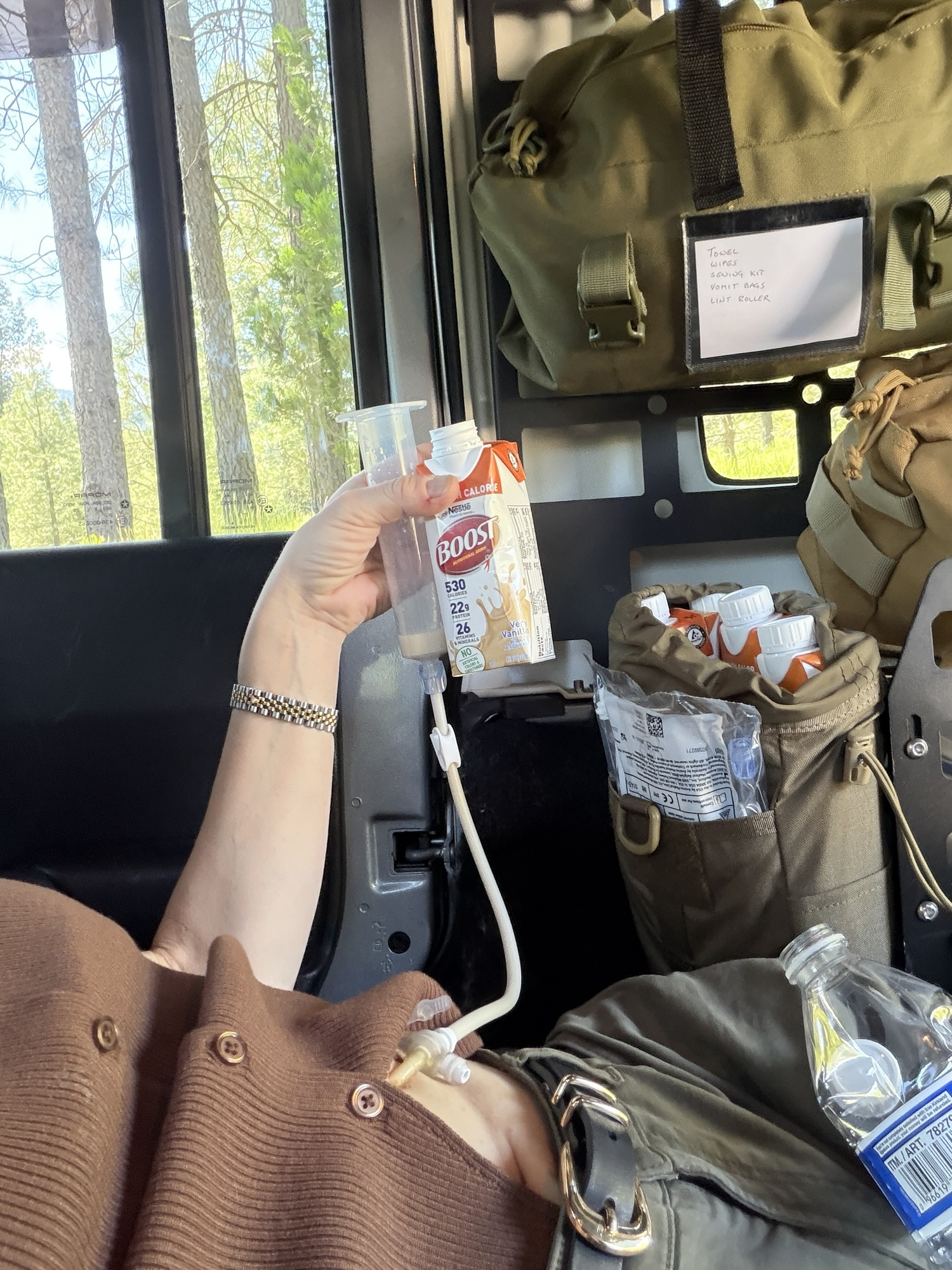
It is easiest to bring all your food with you premade and without needing refrigeration. Even those of us that do blended real food often gravity bolus Very High Calorie (VHC) Boost, ISOsource, or Jevity from cartons when mobile due to the size and weight compared to most formulas or the inconvenience of bringing a blender, cooler, pump, etc. when outdoors. You can flush by pouring water into the syringe body before and after gravity bolus feeding.
I actually found when overlanding and camping (drive to location) the weight, size, ease, and minimal cleaning required to gravity bolus the cartons of VHC Boost was easier than cooking and bring food to eat. I look at it as an MRE I don’t have to taste *wink*… Small upsides, I try and find them. When day hiking I found bringing a few VHC Boost was the same as bringing a sandwich.
You also have the option of pressure bolusing other formulas and meal replacements with calorie additions like you would blended food. This is not as simple as the cartons but gives you more control over the ingredients. I recommend a cordless magic bullet or other electric protein drink mixer to ensure powder and additives are well mixed (to prevent clogs).
Use a water dedicated syringe to flush before and after meals if pressure bolusing. I recommended having a separate water flushing syringe for each day. Use a hard cup (I use a magic bullet cup since it is the right height) to store the water syringe for flushing reuse and keep in your Food and Medicine Bag. This replaces the pop-up cup. I find continuous feed extensions are best when doing medications only.
See Suggested Food and Water Additives
- BENEPROTEIN (Mix and pour into a water bottle and use as your flush water during the day)
- XtraCal Plus Calorie Supplement (Add to liquid meals or directly to tube)
- 1.5oz per serving/packet
- Calories per Serving: 230
- Grams of Protein per Serving: 14
- May Be Added to a Feeding Tube
- Unjury High Protein Meal Replacement (The calories and fat is low but the nutrition and protein is high – good as an additive only to high calorie base)
- Huel Complete meal replacement
- 400 cal per 17 oz of water (plus powder volume)
Continuous Feed Schedule Flex
I don’t have a J-tube, but based on other traveler’s experiences, using a flexible feeding schedule on vacation can be a useful tool.
Whether camping or in a sleeping room, you want to be careful of food outside in the sun. If you’ll be out in the sun while you hangout around the lake or pool, you may want to run water through the pump during the warmer parts of the day and feed overnight. You can have a small feed earlier if needed.
Food and Medicine Bag (Bolus)
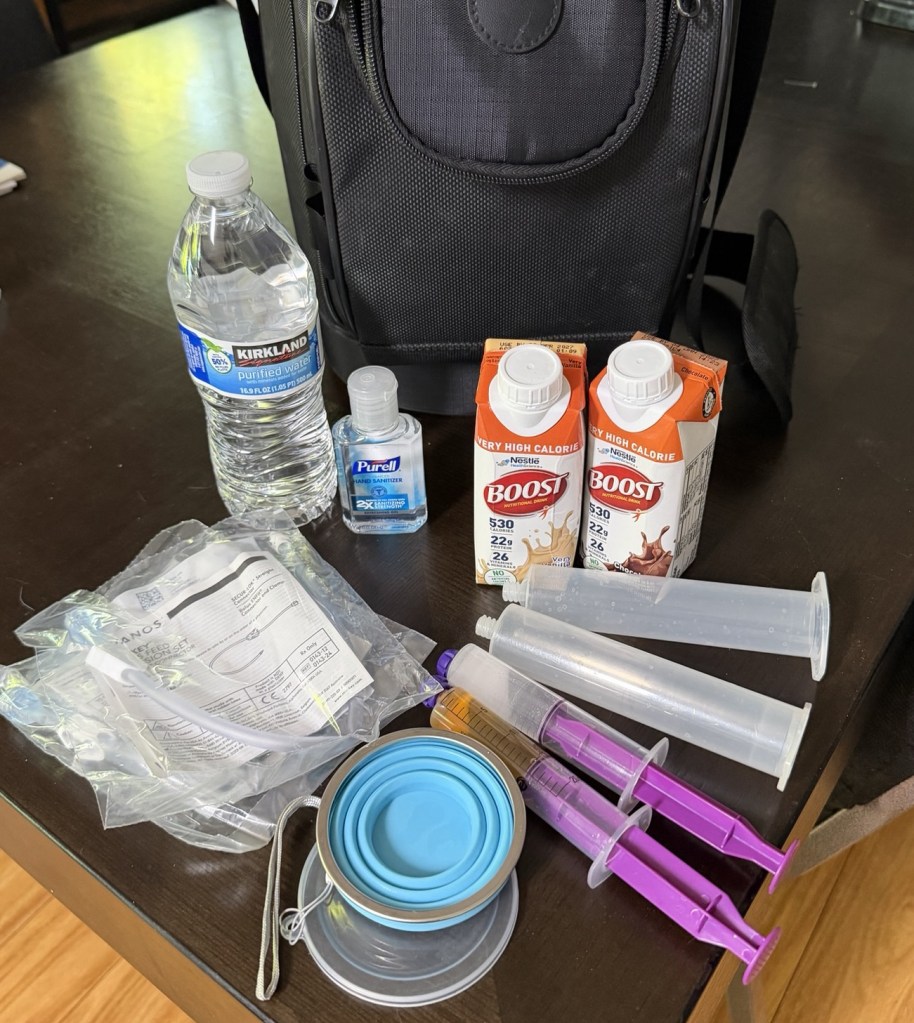
I find the following items are always good to have in my food and medicine bag/backpack. On longer trips I fill it two days worth of supplies at a time.
If you are just going for a hike for the afternoon or out to an event, downsize the Food and Medicine Bag to just the supplies for the number of meals you need and medications you will need to take until you get home, bring gloves and hand sanitizer so you don’t have to worry about finding somewhere to wash up (leave the soap at home) and eat on the go.
TIP: You can flush your meds by using the same med syringe after you administer the medication and filling it from the pop-up cup. This also clears out any leftover medication residue in the syringe.
TIP: You can prime an extension (fill it with water so you don’t get air in your stomach) by placing the tip in water and pulling back with a filled med syringe. Then clamp the extension and disconnect the syringe. “Burp” the syringe to remove the air from the syringe before administering.
Items
- Pre-filled medicine syringes
- 2 days worth of 60ml bolus syringes*
- 2 days worth of extensions (one per meal)*
- Pop-up camping cup (or water flushing syringe and cup)
- Gloves/hand sanitizer <- If you can’t clean you hands well at meal time
- Camping towelettes or equivalent
- Soap leaves/hand soap/wash wipes
- Alcohol wipes
- 2 days worth of food cartons
- 2 chucks (pee pads) to place on dirty surfaces
- Empty gallon ziplock bag for “dirty” syringes and extensions (rinse well before putting in bag)
- 2 days worth of food
- Flush water (refill throughout the day as needs)
*If using a pump or other feeding set up you will want to bring two sets of equivalent daily supplies.
Continuous Feed Backpack
Feeding Pump Backpacks eliminate the need for a pole and are specifically made to allow you to be active while maintaining proper pump positioning. You likely won’t want to carry around two days of formula on your back… HEAVY! So assume you will be refilling your backpack based on how much weight you are willing to carry.
Carry an equivalent amount of supplies and medications to match the amount of formula you are carrying. I recommend going with a medium to larger size if you will be away from base camp for awhile.
It is recommended to always have spare batteries in your Feeding Pump Backpack and a spare pump in your Overstock Meds container or Feeding Pump Backpack if there is space.
Overstock Meds
I recommend packing additional medication items in a latching, hard shelled (plastic/metal), tote or case.
- Extra pre-filled syringes in labeled gallon bags (to refill 2 Day Food and Medicine Bag)
- Crushed tablets.
- I use a Silent Knight pill crusher and leave the powder in the bag, fold it up, and place it in a 2oz jello shooter cup with a lid for transport.
- I write the med name (abbreviation) on the top of the bag and cup lid before crushing.
- I then place the cups flat in a zip lock to make an even layer.
- Stack in layers at the bottom with syringes on top.
- I always bring at least one extra days worth of meds pre-filled or pre-crushed.
- Medication in prescription bottles. (Incase of emergency or spill)
- Hand pill crusher (Incase of emergency or spill)
- Extra 2oz jello cups w/o lids to mix incase of emergency or spill
- Pill cutter (if you need one for your meds)
- Water syringe with markings for meds (5ml, 10ml, 15ml, etc.)
- Extra gloves and alcohol wipes
- “med straw” (extension with tube attachment cut off and ENfit attachment left on tube)
- Spare replacement tube. In the event of yours coming out you want to have one when you go to the ER!
Extra Food
Pack you overstock formula/food however you see fit. Avoid extreme temperatures and placing in direct sunlight. Make sure it isn’t going to get damaging during transport.
Day to day cleaning and stoma care supplies
Having a first aid kit with your day-to-day cleaning supplies and your other hygiene products handy is a must for travel, particular outdoors. It is essential that stoma wound care is kept up on even when camping.
Don’t forget your essential medical, stoma care, and hygiene supplies!
- Gauze, split gaze and tape or adhesive sponges
- Transparent wound dressing
- Saline/wound cleaner, other stoma cleaning and care items
- Extra gloves, hand sanitizer, chucks* (pee pads) *Incase you don’t have a clean eating/med taking area and keeps medication dust off surfaces when crushing
- Hand washing soap and towels
- Dish soap, bottle brush, dish pan for cleaning
- Extra extensions, syringes (continuous feed and/or bolus).
- I bring enough syringe bodies and extensions to last the trip if possible to avoid heavy washing, but packing four days worth for long trips (two in uses, two being washed) is usually really easy to manage.
- Caps, valves, hanging bags, and other feeding and medication administration supplies
- Spare pump, extra batteries
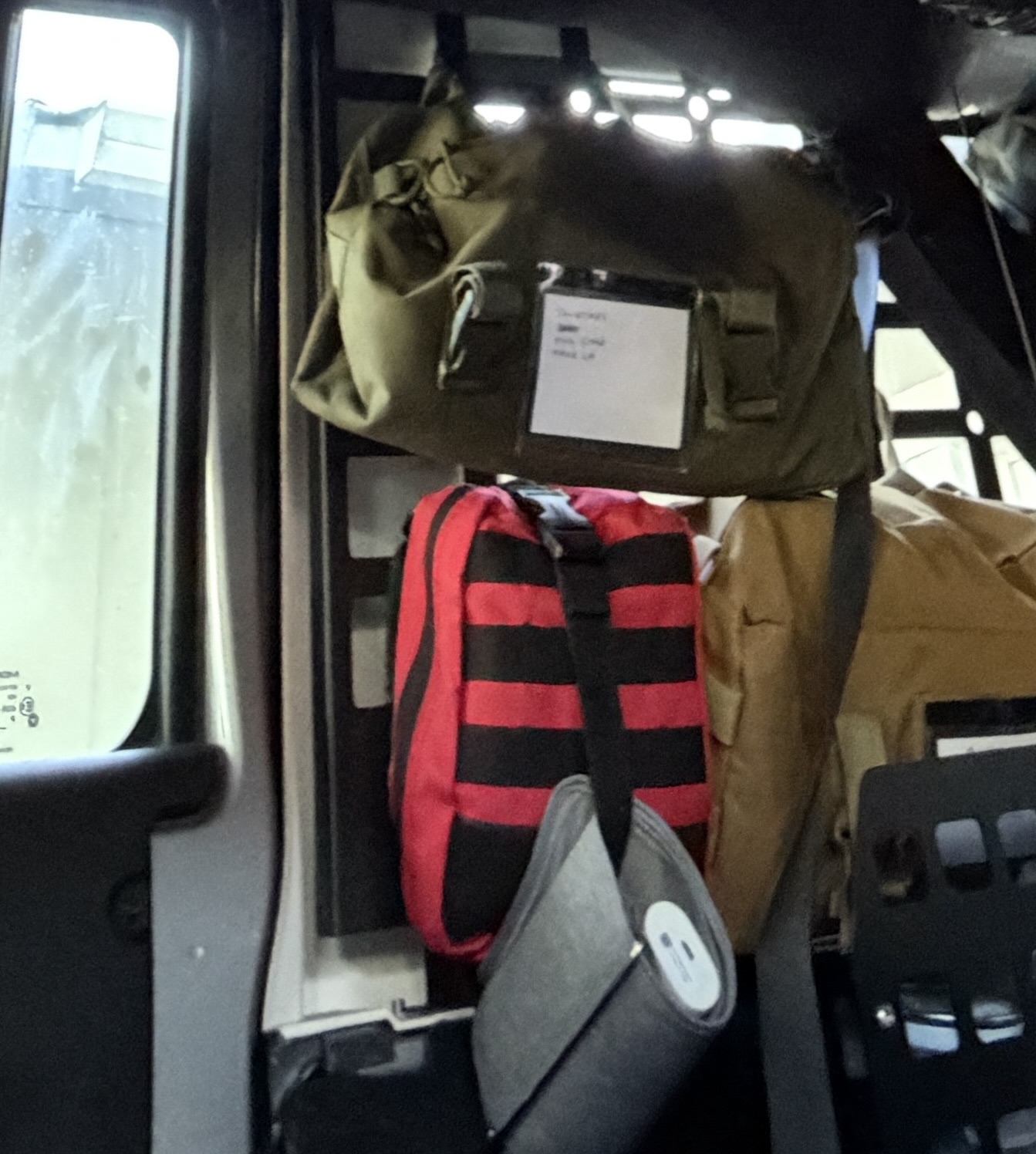
I pack mine and Sam’s belongs in molle-bags and hang them on steel molle in my Jeep to travel/overland but you do you!
Spread Your Wings
If you are flying domestically in the USA and going through TSA you can travel under the Disabilities and Medical Conditions. I have tried to summarize the information that is applicable to feeding tubes (as of May 2026) but the full current TSA Disabilities and Medical Conditions can be found at:
Formula falls under medications and is excluded from the 3-1-1 liquid rule for carry on’s and your feeding and stoma care supplies are considered medical items.
You can have a second, free, carry on bag for medical items and medications. These items should be separated from your other personal carry on items or it will not meet the Disabilities and Medical Conditions.
The following is from the TSA website and is generally is the most relevant:
Medications
Medications in pill or other solid forms must undergo security screening. TSA officers may test liquids, gels or aerosols for explosives or concealed prohibited items. Click for more details.
- You can facilitate this screening by clearly labeling medication.
- Medication can undergo a visual or X-ray screening and may be tested for traces of explosives.
- Inform the TSA officer if you do not want your liquid medication to be screened by X-ray or opened. Additional steps will be taken to clear the liquid, and you or the traveling guardian will undergo additional screening procedures, which may include AIT screening, a pat-down, and additional screening of your carry-on property.
- If officers are unable to use screening technology to clear these items, you may be asked to open them for Vapor Analysis. Screening will never include placing anything into the medically necessary liquid.
3-1-1 Liquids Rule Exemption
TSA allows larger amounts of medically necessary liquids (formula, liquid medications, wound cleaning fluid), gels (skin creams/gels), and aerosols in reasonable quantities for your flight. Click for more details.
*I will bring a minimum 2 days just incase of an unexpected delay and explain I am unable to purchase formula if a flight cancellation happens, if questioned (rarely happens). For short trips you may just bring all your “food” with you.
- You must declare them to TSA officers at the checkpoint for inspection.
- Remove medically necessary items from your regular carry-on bag if you have them mixed in there, and place them in a separate bin or bowl.
- If a medically necessary liquid, gel, or aerosol alarms additional screening will be required. If the alarm cannot be resolved, the item may not be allowed.
Accessories
All items, including supplies associated with medically necessary liquids such as ice packs, bags, pumps and syringes must be screened before they will be permitted into the secure area of the airport. Click for more details.
- Ice packs, freezer packs, gel packs and other accessories may be presented at the screening checkpoint in a frozen, partially frozen or melted state to keep medically necessary items cool.
Don’t forget your essential medical supplies, which includes feeding (life support), taking medications, and stoma care.
- Gauze, split gaze and tape or adhesive sponges, clear wound dressing, saline/wound cleaner, other stoma cleaning and care items
- Extensions, syringes (medication and bolus), caps, hanging bags, spare pump, extra batteries and other feeding and medication administration supplies.
- Medication mixing cups, pill crusher, pill cutter, “med straw” (extension with tube attachment cut off and ENfit attachment left on tube) and other medication preparation supplies.
- Gloves, hand sanitizer, chuck* (pee pad) *Incase you don’t have a clean eating/med taking area and keeps medication dust off surfaces when crushing.
- Spare replacement tube incase of emergency.
Bandages and Dressings
Inform the TSA officer if you have a bandage or dressing. Click for more details.
- Your bandage, compression sleeve or dressing is subject to additional screening, including inspection, hand-held metal detector screening, a test of your hands and a test of the medical item device for any trace of explosives.
- Screening in TSA PreCheck® Lanes
Additional screening is required if your bandage or dressing alarms in the Walk-through Metal Detector (WTMD) or AIT. If required, the TSA officer will direct you to conduct a self-pat down of the medical item, test your hands for any trace of explosives and conduct hand-held metal detector screening on the medical item.
Medical device attached to your body
Inform the TSA officer about the location of medical device attached to your body.
You will not be required to remove medical devices attached to your body. Click for more details.
- Disconnected devices may be screened by X-ray. Inform the TSA officer if you do not want your device screened by X-ray. Alternative screening will be conducted.
- If your medical device is attached to your body, the device is subject to additional screening, to include a self pat-down of the medical device and a test of your hands for any trace of explosives.
- Screening in TSA PreCheck® Lanes
Additional screening is only required if your medical device alarms in the WTMD or AIT. If required, the TSA officer will direct you to pat-down the medical device and will test your hands for any trace of explosives.
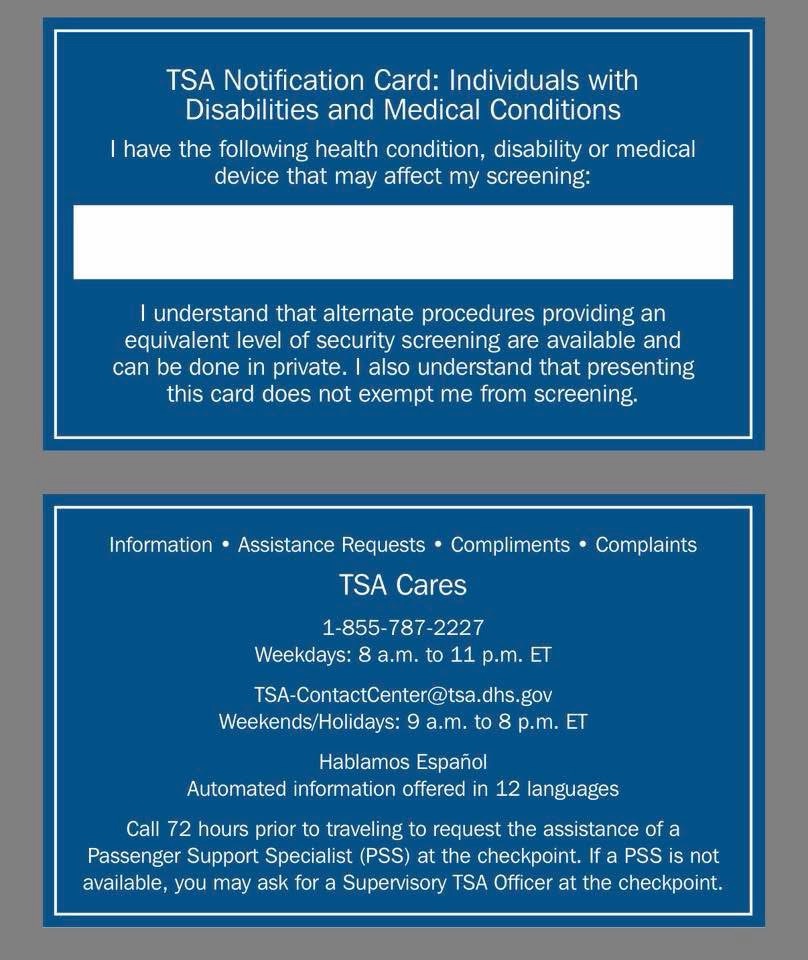
Contact TSA Cares at 1-855-787-2227, 72 hours in advance to request the assistance of a Passenger Support Specialist (PSS) at the checkpoint, to make it as painless as possible to get through security. They will also let you know what to expect and answer any questions about what and how much you can bring. If a PSS is not available, you may ask for a Supervisory TSA Officer at the checkpoint.
You may inform the TSA officer of your disability or medical condition verbally, by using the TSA Notification Card or by providing medical documentation (letter from doctor).
Though not required, it is recommended to bring a TSA Notification Card: Individuals with Disabilities and Medical Conditions as it has good “who to contact” information on the back if you run into trouble.
Contact the Airline, Flying Agent, or Travel Company
It is recommended to contact the airline, your flying agent, or travel agent as soon as you get your tickets, so that they can smoothly accommodate you on the flight. Some request may need to be made by submitting a request, so allow yourself adequate time.
This may do things such as allowing them to board you early so you can situate yourself, giving you seating with adequate space to accommodate supplies and feeds, inform you of weight allowance, etc.
If you run into issues at the gate, you can ask to speak with a complaint resolution official (CRO), which all airlines should have available to handled disability issues.
Cruise Ships
If you will be connecting with a cruise ship they will have their individual policies. You will need to contact your travel agent or the cruise ship for information on what is required.
Based on another traveler’s experience, they ask you to have specific cruise insurance, plus up to 2 to 3 weeks of medication incase of problems being able to disembark.


Leave a Reply